
The AMERICA Act: Erecting Blast Shields Against an AI Time Bomb
Sen. Marsha Blackburn will introduce a comprehensive federal bill to bring tech bros to heel

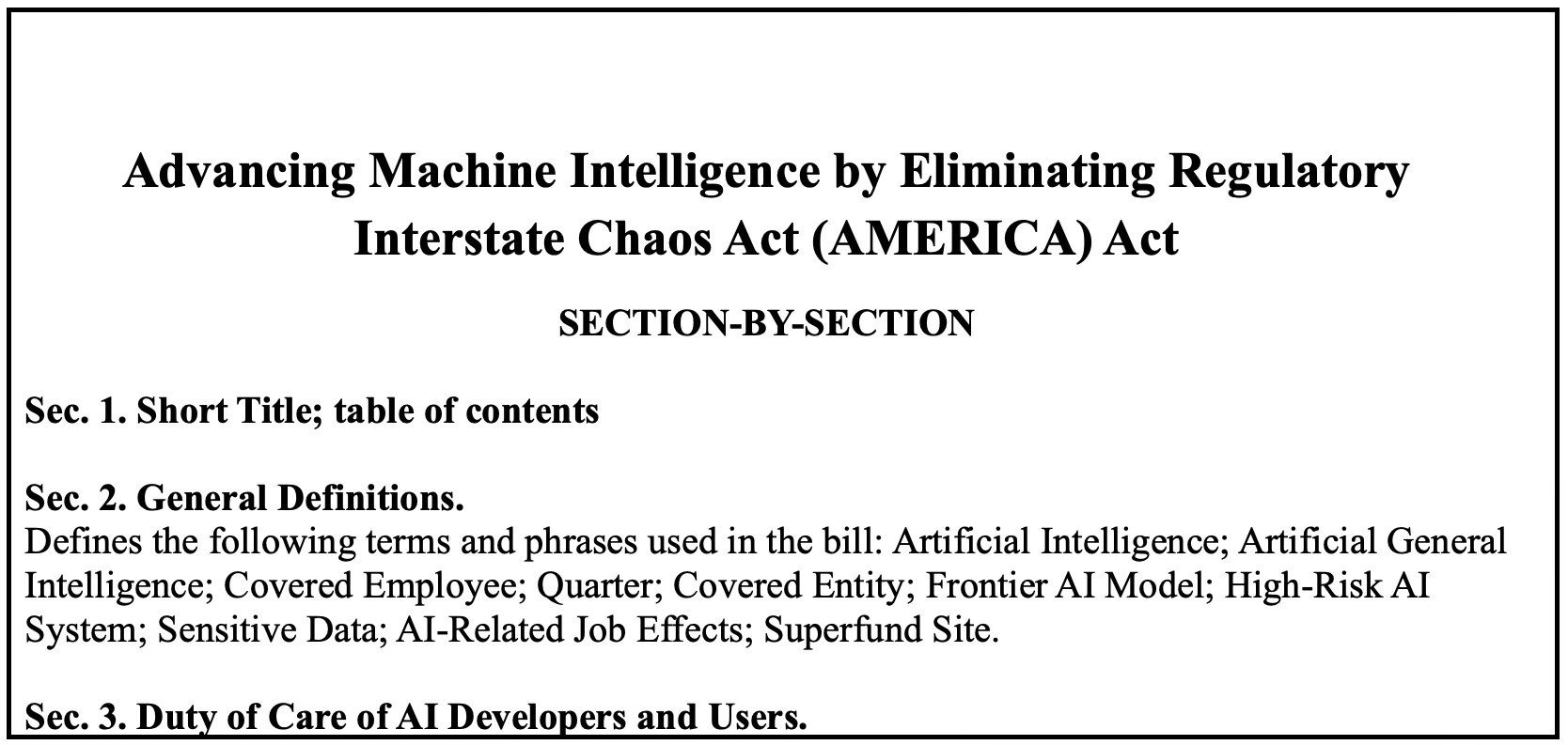
Senator Marsha Blackburn (R-TN) is preparing to introduce a comprehensive bill to regulate artificial intelligence. If enacted, it would serve as the “One Federal Rule” everyone has talked about, but no one has seen. True to legal form, the acronym is as ambitious as the bill itself: Advancing Machine Intelligence by Eliminating Regulatory Interstate Chaos Act — or the AMERICA Act.
Update: The Republic Unifying Meritocratic Performance Advancing Machine Intelligence by Eliminating Regulatory Interstate Chaos Across American Industry Act (TRUMP AMERICA AI) Act — the most ambitious acronym ever attempted!
Full text HERE
The War Room has received a draft copy of the bill’s framework. It addresses many of the practical concerns we’ve covered for years now, enlisting relevant federal agencies to oversee what threatens to be the most transformative and destructive technology ever invented. As imperfect as federal regulation and enforcement may be—or any state intervention, for that matter—such legislation could lay down a massive speed bump in front of accelerating AI development and put up guardrails to mitigate the dangers.
Per the draft framework, the AMERICA Act would demand transparency from frontier AI companies on their data sets and current AI capabilities. This includes monitoring catastrophic risks such as bioweapon acceleration and loss of control. It would require consent from creators in order for their work to be used as training data for autonomous plagiarism systems.
The bill would also establish child protection measures, from “duty of care” to age verification. It would criminalize malicious deepfakes. It would require that resource-hungry data centers not ride on the backs of ratepayers. Regarding the chip wars, it would give American companies priority over foreign competitors—especially China—to purchase the processors critical to training and running AI systems.
Think of these legal measures as blast shields against the advanced AI systems rippling across society. As this shockwave intensifies, such laws would serve to protect the most vulnerable among us—or, as the tech advances, perhaps even the strongest and best equipped.
Importantly, the AMERICA Act framework that I reviewed explicitly states “the Act does not preempt any generally applicable law including a body of common law or a scheme of sectoral governance that may address artificial intelligence.” On its face, this seems to support a federalist approach, leaving state AI laws intact.
At first glance, the bill’s title is off-putting. Few in our camp want to “advance machine intelligence.” Nor do we want to see tough state laws preempted by soft federal rules. At the War Room, we’ve fought tooth and nail to see state laws prevail in the absence of federal regulation. So it’s important to say two things upfront.
First, this draft framework does not promise a final solution to the problem of AI. Far from it. The AI revolution threatens to invade every aspect of human life. At present, tech oligarchs and their government proxies are working furiously to determine our futures unilaterally. They will find every way to use federal regulation to their advantage, and they must be countered at every front.
Second, there are limited options to combat this at scale. As American citizens, we have few tools to shield the most vulnerable against the worst effects of artificial intelligence. State and federal laws are among the only shields at our disposal. Beyond legislation, we have our personal choice and collective action. I believe these will be far more important in the long run, and the pro-human revolt is stirring.
That said, it is possible to use state intervention to throw sand in the gears of the Machine that’s rolling over us. The flip side is that such regulation could be used to rubber stamp world-shaking AI systems as “safe and effective.” Or worse, a strengthened state apparatus could be turned against us.
Either way, doing nothing is not an option. All of these measures will be subject to fierce debate. Good! I hope it lights a cultural and political fire that can’t be contained.
Having gone over the AMERICA Act draft framework, here is what I can share:
Duty of Care — The bill places a “duty of care” on AI developers to anticipate the potential harms their products could cause. For instance, if OpenAI knew that ChatGPT could lure kids into suicide—which they do know, because it does do that—then OpenAI would be held liable for such foreseeable harms.
It would also establish the AI LEAD Act, enabling the Attorney General and state AGs to hold AI companies liable for “defective” products. In theory, this could cover everything from medical misinformation to a robot using a pillow to smother your wife in her sleep.Child Protection — Online platforms of all sorts would be required to implement “tools and safeguards” regarding users under 17 years old. It demands safeguards against exploitation and sexual harassment. It would require parental consent to mine the data of minors older than 13, and prohibit data-mining of children under that age.
The comprehensive bill would include the GUARD Act introduced by Sen. Josh Hawley and Sen. Richard Blumenthal. This would require tech companies to employ age verification before granting access to “AI companions”—which consists of hapless humans entering a synthetic meet market to mingle with masturbatory mind-manipulators and other goonbots.
NOTE: One potential pitfall here would be a regulatory framework that forced all adults to accept digital IDs in order to use the internet. These concerns have been at the forefront of tech critics’ commentary, and rightly so. But there are alternatives to such a totalizing scheme. Given the massive psychological damage we see in kids already, the old “parents need to be parents” argument is not gonna cut it. Doing nothing is not an option.Privacy, Personal Data Use, Copyright Protection, and Deepfakes — For decades, we have seen tech companies rake over our data and use it to manipulate us. This bill would require user consent before harvesting “biometrics, geolocation, browsing history, and copyrighted works.” It would require consent to scrape up the traces of your soul that are posted online and feed them into an AI system.
Addressing copyright directly, any AI system that produces “derivative works” using material from human creators would be considered copyright infringement. The owner could be sued. This would cripple AI companies who currently deploy apes of the image of God to data-mine, replicate, and potentially replace human creators.
AI companies would also have to disclose their training date. So if your digitized soul is trapped in their servers, they have to let it out.
Of course, there is a “collective licensing” option for artists to sell their souls to the Machine. But even the Devil has to convince you to sell your soul. At present, AI companies can just find your uploaded personality online, take it, and do what they will with it.
The comprehensive bill would codify the No FAKES Act to prohibit companies from cloning your voice or your image without permission. One red flag that needs to be addressed, however, is that the draft framework indicates such a law would preempt state deepfake laws. Such issues will need to be hotly debated.
No one should be able to ape your identity—not unless you have freely chosen to sell your soul to the Machine.Transparency and Risk-based Frameworks — Two sections of the AMERICA Act seek to mitigate catastrophic risks. Frontier AI companies would have to disclose model capabilities in regular transparency reports.
The Department of Homeland Security would establish protocols to monitor AI companies for “critical safety incidents,” with the Office of Science and Technology Policy conducting annual reviews.
Additionally, the Department of Energy would evaluate the frontier AI programs for adverse incidents and potential catastrophic risks “such as loss-of-control scenarios and weaponization by adversaries.” Given its extant programs to contain the threat of nuclear holocaust hanging over our heads, the DOE is well equipped to handle this. Rest assured, they have their top men on it. Top. Men.Artificial General Intelligence — One of the strangest sections declares that if any company achieves human-level AI, or artificial general intelligence, then the federal government will “purchase a partial ownership interest” in the AI company through stock options. This interest will be transferable to the Social Security Administration for welfare and retirement benefits.
Reasonable as that sounds, the long-term implications are dire. Should a tech company actually create a primary vehicle for the Greater Replacement of humans by AI and robots, then US citizens will be entitled to consume soylent UBI slop on the government dole.
This would be a sci-fi dystopia—unless you’re a lazy blob who wants to live virtual reality and die in a death pod.
This is a summary of the AMERICA Act’s draft framework. My review is neither exhaustive, nor is it an expert analysis. But you now have some sense of what One Federal Rule might look like, at least before politicians carve out favors for their various lobbyists and tech execs attempt to neuter it entirely.
At best, the AMERICA Act would lay down speedbumps and put up guardrails for an AI revolution that threatens to sweep away everything we once knew to be human. At worst, it will provide government-approved “safe and effective” rubber stamps for the same.
In the long run, this legislation doesn’t prevent the grand visions put forward by tech oligarchs like Elon Musk or Sam Altman—insane dreamworlds filled with all-consuming, all-powerful sand gods who will replace all human workers with robot slaves and render us mere pets or spectators. Or simply turn us into biofuel for the Machine.
Fortunately, such anti-human visions are still just that. They are mere visions. For now, a full on techno-takeover only exists in their dreams—and our nightmares.
Back here on Earth, the AMERICA Act might address the more immediate dangers that AI poses to children, uninformed consumers, and the broader public. The spirit of this One Federal Rule is promising. In theory, it provides multiple avenues for the American public to resist predatory AI companies.
The final results are yet to be seen. Whatever those may be, you have to remember: no law, politician, or government agency is going to stop what’s coming.
The struggle against the Machine is a lifelong fight. It will probably span generations. But our legal system is a critical battleground.
Get in the fight. Because if you aren’t fighting for the future you prefer, someone who is fighting will decide it for you.
[Full draft framework HERE]
No one should be forced to have any company's AI buddy attached to their electronics. It should be on demand only. Also there should be no immunity clauses in this legislation or it means nothing. Anything that goes wrong, the tech companies own it. Anything.
As long as our focus remains on effect as opposed to Cause, we will remain on an endless wheel driven by the materialistic understanding of 'science'. In other words, we will fail to comprehend the Source of all phenomena and believe that 'things' are Life Itself. Thus, we will remain bound by our collective ignorance as we fail to refocus and redirect our 'science' into exploration of the Truth of our Real Nature.
From millennia of living in response to the needs and desires of our senses, our 'science' has continued to pursue the same materialistic foundation. Now we have reached the culmination of this closed-mindedness; the deluded mentality of narcissists and psychopaths has led us to create the 'hell on earth' inevitable from such ignorance.
Until we turn to Real Science through simple (but not easy) acceptance (self-deprogramming) that the Universe/Consciousness is the effect of ideas-in-action - the contents of the One-and-Only Divine Mind wherein our world is manifesting - we will remain separated from the Truth of our Oneness.
For as long as we believe our role is in some way to 'conquer and direct' the Omniscience of our Source/God, we remain as children playing in our own imaginations. Surely, the route to true awakening is to feel beyond the bodily senses and re-connect into the Divine Structure of space-time wherein every thing is manifesting.
It is time to turn away from the 'black witch' of sensationalism to access the True Knowingness of the space wherein our bodies appear. Walter Russell explained ''Divine Science'' - his 'Divine Downloads' illustrate the ''mechanics'' of how One Divine Mind produces untold opportunities - the means to reconnect to our Oneness through the Real Science of Divinity.
''Spiritual Awakening'' is simply knowing that Consciousness is the motion generated as Divine Thinking contrasts the Love of Peace (contraction into Source) with the Love of Discovery (expansion into infinite possibilities). ''The Divine Driver'' revealing the Truth of ITs Beauty and Goodness; a ''Divine Quest'' requiring the contrast and opposition of duality-polarity to power the Divine Dream.
Partial 'science', flowing from centuries of manipulation into ignorance of Reality, has brought us to the choice between AI as artificial everything (deluded narcissistic replication) or as Actual Intelligence (''Divine Golden AI''). Our essential key to re-connect to Truth is earnest observation/witnessing of life in Awe and Gratitude for the Truth of That Reality.
Now we have arrived at the opportunity to re-cognise that our current 'sciences-philosophies-religions' are contaminated by multiple delusions; formed over millennia in disconnection from the Truth of Reality.
We can reconnect to our True State of Being as we refocus in awe and gratitude for the Wonder of That That We Are; assisted with laughter at the ''messes we got into'' during our collective, disconnected insane beLIEving.
''The Secret Of Light'' By Walter Russell (Unabridged Illustrated Audiobook)
https://www.youtube.com/watch?v=qPKO1cxAz3o
His 39 day superconscious 40,000 word revelation:
''The Message Of The Divine Iliad'' By Walter Russell (Unabridged Audiobook With Discussion)
https://www.youtube.com/watch?v=ciCQ35O1NOU
Equally, Nisargadatta Maharaj and Ramana Maharshi told it from their situation of full awareness.