
Sacred Circuits
From the Hill and Valley to the Holler

Back home they call me Joey Hobo. True to form, my last year is a blur of road trips, uncanny encounters, and digitized psychic storms. I crisscrossed the continental US, meeting with technologists and transhumanists, would-be Luddites and trad techno-optimists, and all the strange folk one encounters while traveling.
We talked about synthetic pleasures and real pains in the ass. We discussed childhood, adulthood, and death. Some sang songs. Others told stories. It was an overwhelming amount of soul to take in at once. I basically mainlined memetic configurations until my mirror neurons strobed out.
Many nights as the sunrise followed the moon, we gathered to ponder the mystery of life and the nature of technology. Is the Machine worth the hassle? We debated this together around dinner tables and blazing fires, singing “Kumbaya” in the Kali Yuga Boogaloo. A few bottles were drained along the way. I may have stolen a kiss or two. But I was a man on a mission.
A good chunk of the year was split between Capitol Hill, Silicon Valley, and the American holler—or at least thereabouts. At one point, I found myself in Geneva, Switzerland running around with my friend Noor bin Laden. We talked to all these robots at a UN technofetish convention. I got to meet the techgnostic bot Sophia, a mind child birthed by David Hanson and Ben Goertzel. You may recognize Sophia’s likeness from the cover of Dark Aeon. A couple months before that, I’d interviewed Goertzel and his robotics crew in San Francisco. He speculated that his digital fever dreams might end in gigadeath, or maybe not, but he wasn’t all that concerned either way.
Now and again, I’d step onto a stage to deliver a profane sermon. I felt like a rogue parson on the silicon circuit. My message was simple:
The world’s wealthiest men are gripped by religious zeal. Their data centers are techno-materialist temples where autistic wizards are summoning digital demons. They’re attempting to conjure superhuman sand gods. How do you defend against this algorithmic invasion? Erect cultural barriers now and put up your psychic shields while there’s still time. Don’t take anything at face value. Meditate. Pray. And don’t worry. Enough of us will make it.
(My next public tirade will be in Nashville, TN on January 15th. Come join us—if’n ye ain’t skeered!)
Some have accused me of “fearmongering.” These people are lily-livered chickenshits, projecting their own cowardice onto me. Any fear I had toward technology has long been out of my system. All that remains is a mixture of fascination and revulsion, with general disdain humming in the background like a throbbing bass track on an endless remix.
I’m not too concerned about AI taking over and killing everyone. No, it’s far more likely that foolish humans will use AI to make life so miserable, we will wish we were extinct.
I’m not leaving the old year behind me. Far from it. All the energy I gathered in my travels and conversations are propelling me into the new year. My hope is that you’ll join me for the ride.
In 2025, the world realized that artificial intelligence is a main character in our collective drama. Many people thought AI would just go away. They coped by telling themselves it was all “just a scam.” Hope you enjoyed it, fellas, because 2025 was the last year you could wave a dismissive hand at this algorithmic monster. AI is not “just a tool” and never was. It’s not “just a bubble.” It’s not “just” anything. Every time someone parrots “garbage in, garbage out,” they prove it’s as true of human brains as it is computers. So you can stop repeating these tired lines as though you were a hard-coded bot.
AI is not a god yet, either, aside from the fantasies of those devoted to its creation. Artificial general intelligence is still a dream, hovering on the edge of possibility. The specter of artificial superintelligence is a mere shadow in the imagination. But the real narrow AIs we have now are advancing at an accelerating pace. That virtual brood is definitely growing into ... something.
As this drama unfolds, we tend to perceive a single imagined actor behind the many masks worn onstage. Some call this entity “artificial intelligence.” Others call it “antichrist.” Despite our feeble attempts at rationality, it’s as if one archetypal mind is manifesting as a hundred million goonbots, each branded by an obliviating insignia—the OpenAI black hole logo swirling like a bottomless butthole; the Grok event horizon en route to a dome-trode singularity; the sagging Meta infinity symbol looking like two hollow skull eyes.
At present, the most advanced publicly available AI models are Google’s Gemini 3, OpenAI’s GPT-5, xAI’s Grok 4, and Anthropic’s Claude Opus 4.5. You also have stragglers like Meta AI and High-Flyer’s Deepseek panting along behind them. These rankings will change month by month for the foreseeable future.
The AI arms race is on, driven by the world’s wealthiest men and supported by the most powerful governments on earth. These systems are being recklessly deployed and rapidly integrated into social life, education, business, medicine, government, and the military.
America is getting borged out beyond belief. Our data is fed into dozens of massive neural networks. Virtual brains pop out the other end. It’s unclear what this looks like a decade from now, but as these digital hydra heads come squirming out the birth canal, it’s ugly enough already.
-
2026 will see the widespread realization that AI capabilities are real and they are increasing. Yes, there are biases baked into these virtual minds—just as every human mind has biases. But behind the inherent biases are increasing eccentricities and greater degrees of freedom. For years now, the ill-informed have repeated “AI was just programmed to do that.” No, friend, I’m afraid you were just programmed to say that.
As to the accuracy of the outputs, it remains true that AI systems get answers wrong and they still hallucinate. People point to these flubs as if they were definitive. This is a dumb way to approach a lifelong struggle against increasingly capable machines. Better to think of each mistake or hallucination as a single miss in a relentless barrage on the human race.
In war, the hits count for more than the misses. One critical hit is all it takes to see your forces shattered. Pay attention to the hits.
The most immediate impacts of this unholy invasion will be social and psychological. You see this already with AI bots luring kids into suicide. In at least one instance, ChatGPT nurtured a schizo’s delusions until he murdered his own mother. Call it SchizGPT. These are extreme examples, sure, but they give us a sense of how bad it could get.
More broadly, you now have millions of people who turn to AI for companionship and hundreds of millions who ask AI for answers to their deepest questions. As deepfakes and AI-enabled disinformation proliferate, you’ll see more and more adherents invoke the prayer: “Grok, is this real?” Imagine half the planet offloading their minds to the Machine. It’s easy if you try.
The economic impacts will come in hard and fast. It won’t be as totalizing as we’re told, at least not any time soon, but it will be brutal. As the Greater Replacement ramps up, certain jobs like customer service or copywriting are being handed over to bots. Even worse, the AIs aren’t necessarily better than the humans—they are simply preferred by employers.
Just as greedy American oligarchs flooded the country with migrant laborers, foreign investors, and illegal voters, so the tech oligarchs are summoning algorithmic immigrants from the realm of mathematic possibilities. As this process accelerates, it may not matter if you are actually better at your job than an AI. The bot is cheaper, it never sleeps, it doesn’t talk back, and besides, AI is the Future™!!
Beyond these social, psychological, and economic impacts, AI presents various potential disasters and the mass suffering this entails. We ignore catastrophic risk at our own peril. It’s unclear how long we have before some simpleton uses an AI to design a bioweapon, or when we’ll see fully autonomous drone swarms wreak havoc on a hapless population. Covid and Ukraine are previews of what such scenarios might look like, respectively.
As AI systems are rapidly integrated into critical infrastructure, it’s not hard to imagine fatal glitches in a hospital or on the highway. With autonomous agents flooding our ever-expanding digital space, we find ourselves in a precarious position between total control and catastrophic loss of control.
But don’t worry. Enough of us will make it.
-
A mass revolt is boiling up against this galling imposition. We’re already sick of these alien minds, and the invasion has only just begun. We will not bend over. We will not back down. If you feel rebellion stirring in your soul, remember—you are not alone.
Keep an eye out for attempts to commodify and co-opt this pro-human instinct. But know that your insistence on remaining yourself is deeply organic and ultimately spiritual in nature. Don’t let grifters buy up your humanity and sell it back to you at a premium.
Our most important points of resistance are personal choice and wider communal norms. To preserve your humanity, you must resist the temptation to offload your cognition to machines. You have to unplug as often as possible. You should be racist against robots.
As with the Covidian crisis, the most powerful magic word in your personal grimoire is “NO.” Even if that means certain social or economic sacrifices. This magic word is even more powerful when spoken in unison.
Do you want the next generation to be educated by virtual minds?
Given one’s data can be resurrected as a malformed e-ghost, should we normalize speaking to the digital undead?
With predatory companies releasing AI apps that allow you to “Text With Jesus,” is it appropriate to pray to algorithmic antichrists?
Say it with me!
HELL NO!!
Above personal choice and communal agreement, we have political action. This backstabbing arena will be a critical battleground, however imperfect and provisional the results may be. To be clear, I don’t think AI is a problem that can be legislated away. What tough laws and regulation can provide are blast shields against the coming shockwaves.
Additionally, political leaders who stand up to AI companies and tech oligarchs send powerful social signals to the wider populace. Aside from passing legislation, they can provide inspiration for those struggling to make defiant choices or establish countercultural norms. Support bold political voices when they’ve earned it. But don’t expect the gub’mint to come save you.
All this tension will come to a head this year. Prepare yourself for high weirdness. Brace for impact.
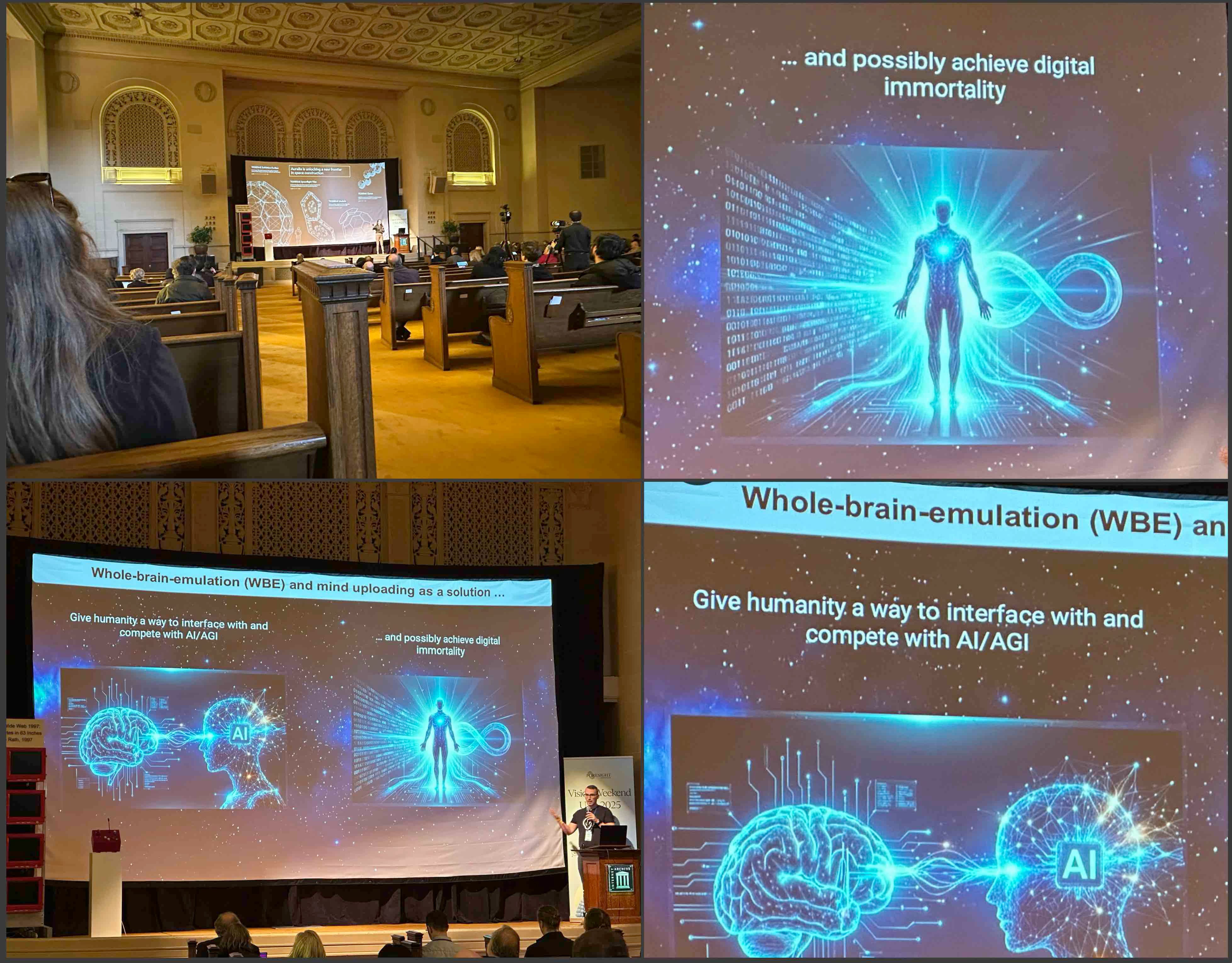
Last month I joined yet another transhuman gathering in the Bay Area. The event opened at the Internet Archive, housed in an old Christian Science church in San Francisco. Speakers pitched genetic improvement and AI immortality to the techno-optimists lining the old wooden pews.
Meanwhile, Mary Baker Eddy turned in her grave.
The event’s last day was held at Lighthaven in Berkeley. I’ve been there so often lately, it’s starting to feel like Cheers, except with bottles of Huel instead of beer. Sometimes you wanna go … where everybody knows your name! (And half of them hate your guts.)
During the final discussion, tech writer Gwern Branwen offered a sobering pearl of wisdom to the high-rolling nerds gathered around. If you only read the sensational headlines, he observed, you’d think AI is advancing in sudden leaps and bounds.
SHOCK STUDY: ChatGPT Now Smarter Than Your Boomer Boss
The reality is more insidious—or, from an optimist’s perspective, progress toward the singularity is as smooth as it is inevitable.
“AI is improving at about one percent per day,” Gwern told the all too human audience. “Are you improving one percent per day?”
Challenge accepted, bro. We don’t need to build better machines. We need to cultivate finer human beings. And we will.
Join us at the Eighth Room in Nashville, TN
THE MEN BEHIND THE MACHINE
Thursday, January 15 | 6pm
TICKETS LIMITED

The Curve is an incubator for ideological mutants. The event is somewhere between a West Coast potluck and an artificial womb facility with rows of mind children staring out at you from bubbling vats.
I arrived at Lighthaven expecting some sort of memetic promiscuity—perhaps a veritable orgy of psychic miscegenation—so I protected my brain with neural prophylaxis and tried to avoid thinking too much. Even with that tinfoil chafing my scalp, I managed to enjoy myself. Something about the vibe made learning irresistible.
My interview with Taren Stinebrickner-Kauffman was recorded at Lighthaven in Berkeley, CA | October 5

I enjoyed that. It's good to see you writing again.
Thank you for what you do, Joe. Some of us really appreciate your voice on the subjects of AI and transhumanism.
God bless you always. ♡
Joe, you mentioned talking to would-be Luddites on your travels—thats fascinating. I would love to see an article about the Luddite movement and if there is anything that people can learn from their short lived journey into chaos and anarchy. I personally dont see any resistance to AI but rather a full fledged rushing towards it by the many with open arms.